
Knox County Court Records After a Jail Arrest
After a Knox County jail arrest, the public custody path and the court-record path separate. The Knox County Jail roster, operated through the Knox County Sheriff's Office under Sheriff Daniel J. Weckesser, can show the arrest date, hold reason, and charge text associated with custody. Formal court records live in the court systems. Misdemeanor, traffic, and local ordinance cases commonly route to Mount Vernon Municipal Court. Felony matters move into Knox County Common Pleas Court when indicted, bound over, or otherwise filed there. Juvenile matters may involve Knox County Probate/Juvenile Court and are subject to stronger access limits.
The jail record and court record should be read together, but they are not the same document. For custody status, booking entries, and the PDF roster, use the Knox County jail inmate records path. For booking-photo context, use the Knox County jail mugshots page. The court record is the case file that follows the charge, including the complaint, information, indictment, docket events, bond orders, pleas, trial entries, disposition, and sentencing when those items are public.
How to Find Knox County Court Records After an Arrest
Start with the official custody entry if the person is still listed in the Knox County Jail PDF roster. Note the name spelling, arrest date, hold reason, and Ohio Revised Code sections shown there. Then choose the likely court. Mount Vernon Municipal Court handles many misdemeanor and traffic cases through its public case-search system. Felony filings and felony docket events are searched through the Knox County Common Pleas Clerk public records and e-filing portal. Probate or juvenile matters require extra caution because the public search may not show every record.
- Open the likely court portal: Common Pleas Clerk eServices, Mount Vernon Municipal Court case search, or Probate/Juvenile Court record search.
- Search by defendant name first, then narrow by case number, filing date, or charge text if the portal allows those fields.
- Open the case record and compare the court charge list with the jail roster charge or hold reason.
- Review docket events for arraignment, bond, preliminary hearing, indictment, plea, trial, disposition, sentencing, probation, or warrant activity.
- If the online search does not load or does not answer the question, contact the clerk's office or visit during regular business hours.
The Knox County Common Pleas Clerk public records/e-filing portal is the main local entry point for Common Pleas cases. The Clerk of Courts contact listed in the research is Christy Milligan Staton, 117 East High Street, Suite 201, Mount Vernon, Ohio 43050, phone (740) 393-6788, with office hours Monday through Friday from 8:00 AM to 4:00 PM, closed weekends and holidays. The Mount Vernon Municipal Court site links to Case Search, Criminal Traffic Division, Civil Division, and payment functions. The court is at 5 North Gay Street, Third Floor, Mount Vernon, Ohio 43050, phone 740-393-9510.
Court Search Fields and Access Limits
The court-search screens documented for Knox County are public access points, but the research found JavaScript, cookies, and disclaimer screens before the searchable fields are exposed. That means a browser may show more options than a text-only inspection. When a search screen does not display fields, use the clerk contact information rather than guessing at case status.
| Portal | Fields Visible in Research | Access Notes |
|---|---|---|
| Knox County Common Pleas Clerk eServices | Search fields were not visible in text inspection. | JavaScript and Wicket session required. Use a browser and expect party or case-number search after the portal loads. |
| Mount Vernon Municipal Court Authority Web Connect | Disclaimer and continue screen visible before fields. | Public portal with no paid login seen. JavaScript acceptance is required before case-search use. |
| Knox Probate/Juvenile Court record search | Disclaimer and continue screen visible before fields. | Juvenile records may be limited. The court warns that posting can lag behind filings or judicial action. |
The Knox County Common Pleas Clerk portal is the matching source for the Common Pleas portal image.
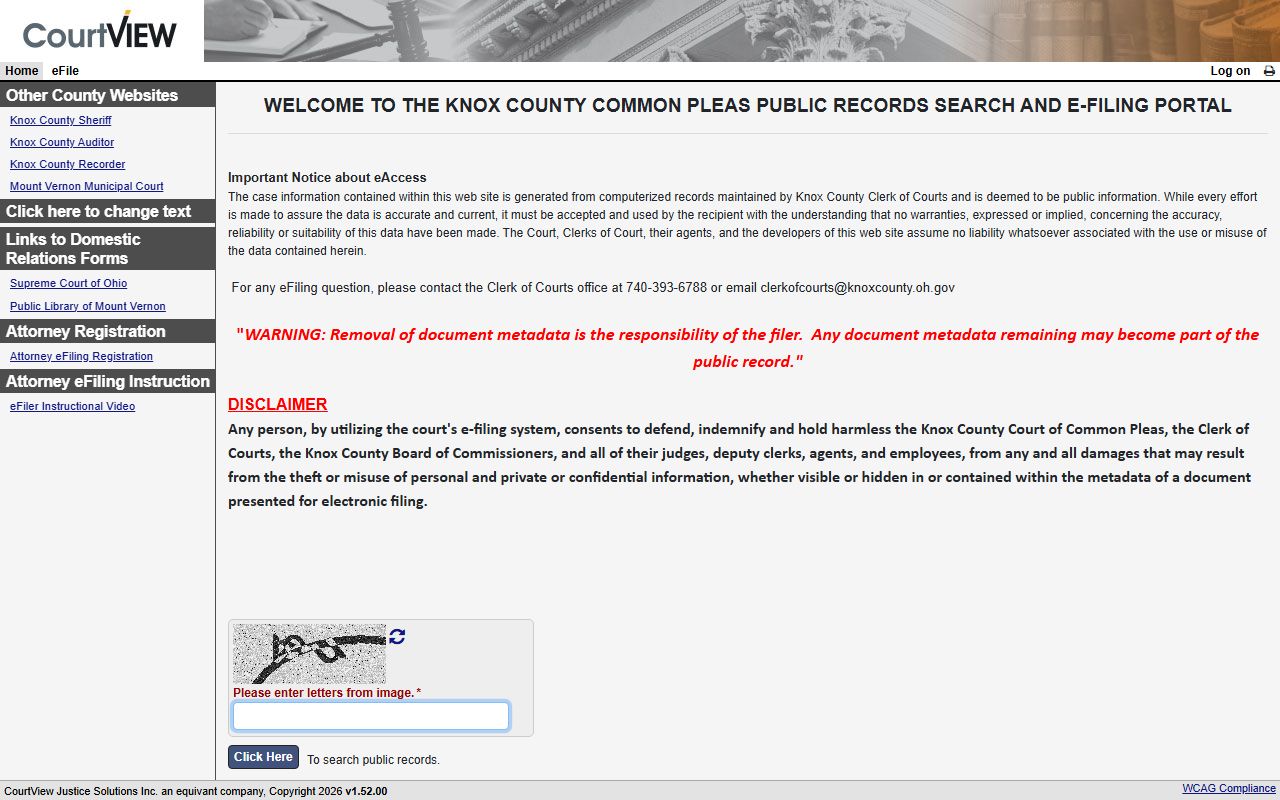
This portal is important for felony court records after an arrest because the prosecutor's filed charge and later docket activity may appear there after the case reaches Common Pleas Court.
The Mount Vernon Municipal Court Authority Web Connect case search displays a disclaimer and continue screen before the searchable case system.
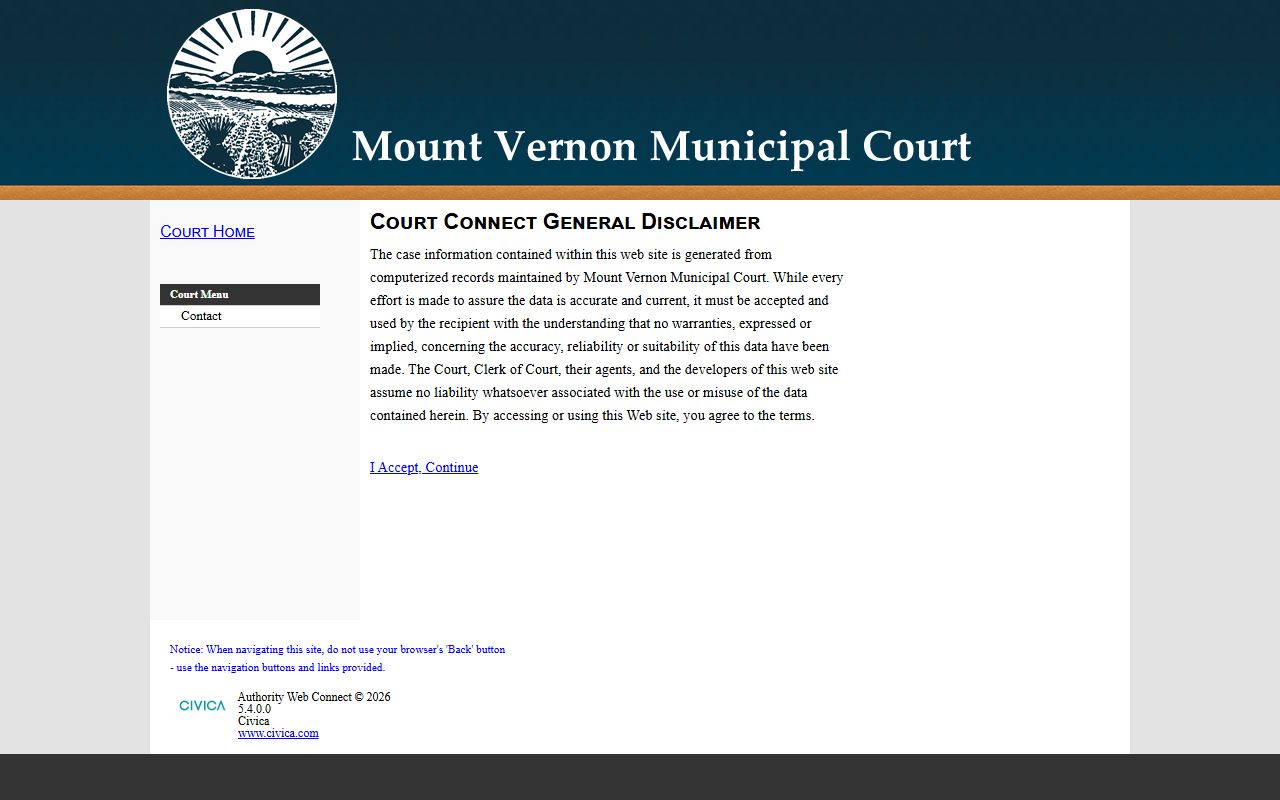
That disclaimer matters because Municipal Court records may be current only within the limits of the computerized court records, and the court does not warrant accuracy or currentness from the public portal alone.
How Charges Get Filed After an Arrest: Complaint, Information, and Indictment
Booking at the Knox County Jail does not by itself prove a final criminal case outcome. The court case begins when a proper charging document is filed or returned. Prosecuting Attorney Chip McConville's office prosecutes felony criminal cases in Knox County Common Pleas Court and juvenile cases, and the office advises the sheriff's office and county police departments. The charging document explains why the case is in court and gives the court a record to track.
| Complaint | Information | Indictment | |
|---|---|---|---|
| Filed By | Officer or prosecutor through the court process | Prosecutor in appropriate cases | Grand jury returns the charge |
| Common For | Initial criminal allegations, including many misdemeanor or first-stage cases | Formal prosecution where an information is permitted | Felony prosecution after grand-jury action |
| Role in the Case | Starts or supports the court case from the accusation and probable-cause process | States the prosecutor's formal charge | Moves a felony accusation into Common Pleas prosecution |
| Why It Matters | May differ from the jail roster wording | May replace or refine earlier booking charge language | May add, drop, or change the charge list from the original arrest |
Charge Status in Court Records After a Knox County Arrest
Charges can change after arrest. The jail roster may list the arrest hold reason or booking charge, while the court file records what the prosecutor files and what the judge later orders. A charge may be amended, reduced, dismissed, bound over, or resolved by plea, trial, acquittal, conviction, or sentencing. Always read the status for each charge rather than assuming that every charge shown on an old roster remained active.
| Status | What It Means | What to Check Next |
|---|---|---|
| Pending | The charge is filed and has not reached final disposition. | Review the next hearing, bond order, and docket entries. |
| Amended or Reduced | The filed charge changed from an earlier version, often by prosecutor action or plea negotiation. | Compare the amended count with the original booking charge. |
| Dismissed | The court record indicates the charge was ended without a conviction on that count. | Look for whether other counts remain open or were resolved separately. |
| Nolle Prosequi | The prosecutor declined to continue prosecuting that charge at that time. | Read the docket entry carefully because wording and effect depend on the case record. |
| Bound Over | A lower-court matter moved toward Common Pleas felony handling. | Search the Common Pleas Clerk portal for the later felony case. |
| Guilty, No Contest, Acquitted, or Sentenced | The case or count reached a disposition or judgment stage. | Read sentencing, probation, jail-credit, and fine/cost entries if they are public. |
Bond and Release After an Arrest
Knox County-specific online bond posting instructions were not located in the research. Do not assume online payment, accepted tender, or release eligibility from a roster entry. The practical route is to call the Knox County Jail at (740) 399-3940 for current custody and hold status, then check the relevant court docket for bond orders. If a person is held on a warrant, parole violation, probation hold, out-of-county hold, federal hold, or no-bond order, paying a local bond may not cause release.
| Bond or Release Type | How It Works |
|---|---|
| Recognizance or PR | Release based on a promise to appear, with no commercial surety needed. |
| Cash Bond | Money is deposited under court or jail rules. Confirm the court order before attempting payment. |
| Surety Bond | A bail agent or surety guarantees appearance. Ohio bonding requirements still apply. |
| No-Bond or Detention Order | A court order or statutory detention decision prevents release by simple payment. |
| Out-of-County Hold | Another jurisdiction must clear the hold before Knox County can release the person. |
| Parole, Probation, or Federal Hold | State supervision or federal court and U.S. Marshals custody rules can control release. |
Warrants That Lead to an Arrest
No official Knox County Sheriff's Office active-warrant database was located during the research. The sheriff records page provides a confidential crime tip line at (740) 399-3959 for suspected criminal activity, including wanted persons, but that line is not a public warrant lookup. Court records are the more practical path for many warrant questions. Mount Vernon Municipal Court case search may show municipal warrant activity, Common Pleas Clerk eServices may show felony docket entries, and Probate/Juvenile records may be limited by confidentiality.
A warrant can be an arrest warrant tied to a criminal allegation or indictment, a bench warrant for failure to appear or noncompliance, a search warrant, a fugitive or out-of-county warrant, or a failure-to-appear warrant. Knox roster charge lines can include failure-to-appear citations under ORC 2937.43 or 2937.29. If the person is held for another county, the Knox roster may show language such as "Held for other county," and the issuing jurisdiction must be contacted for the underlying case.
Charges vs. Convictions
An arrest and a filed charge are not the same as a conviction. The roster and the first court filing document accusations and custody reasons. A conviction requires a plea, verdict, or judgment entered in court. This difference is especially important when reading court records after a jail arrest, because an old booking charge can remain visible in one record source even after a court count is dismissed, reduced, amended, or resolved differently.
| Charge | Conviction | |
|---|---|---|
| Stage | Accusation filed or listed after arrest | Final finding by plea, verdict, or judgment |
| Standard | Based on complaint, probable cause, indictment, or prosecutor filing | Requires the legal standard for conviction in the criminal case |
| Where It Appears | Roster hold reason, complaint, information, indictment, or docket count | Disposition, plea, sentencing, or judgment entries |
| Practical Meaning | Does not prove guilt | Shows the court reached a conviction on that count |
Sealed vs. Expunged Arrest Records
Ohio public access rules begin with ORC 149.43, the Ohio Public Records Act, but criminal records can be limited by exemptions, juvenile confidentiality, investigative restrictions, and court sealing. ORC 2953.32 provides Ohio's sealing process for eligible criminal records. If a Knox County case has been sealed, public court search results and related arrest records may be withheld or redacted. Eligibility and effect depend on the exact disposition and court order.
| Sealed | Expunged | |
|---|---|---|
| Public Visibility | Hidden from ordinary public access by court order. | Treated under Ohio law as removed to the extent the specific expungement law allows. |
| Record Source | Court, clerk, and law-enforcement records may stop appearing in public search. | Public-facing records may no longer be available depending on the order and statute. |
| Access Limits | Some government or law-enforcement access may remain. | Access is more restricted, but the exact effect depends on Ohio law and the court order. |
| Knox County Search Result | A portal may show no public case, a limited entry, or a redacted record. | A public user may not find the record even if older web copies or references once existed. |
Prosecutor Role in Filed Charges
Ohio uses the title Prosecuting Attorney, not District Attorney. Knox County Prosecuting Attorney Chip McConville's office is at 117 East High Street, Suite 234, Mount Vernon, Ohio 43050, phone 740-393-6720, fax 740-397-7792. Office hours are Monday through Friday, 8:00 AM to 4:00 PM, closed weekends and holidays. The office includes Criminal, Civil, Appellate, and Victim/Witness Assistance divisions.
The Criminal Division prosecutes criminal cases in Knox County Common Pleas Court and Juvenile Court. Staff identified in the research include Assistant Prosecuting Attorneys Christine Williams and Nicole Derr, Victim Advocate Liz Ewers, legal assistants Michele Scott and Kayleigh Stainer, and Administrative Assistant Kimberly Shelton. For active cases, the prosecutor may pursue or amend charges, but case status and filed documents should be checked through the appropriate clerk or court portal.
Background Check Considerations
Public court searches are useful for checking docket status, charge language, and case events, but they are not the same as a regulated employment, housing, credit, insurance, or tenant-screening background check. Public portals also warn that computerized records may lag behind filings or judicial action. The Probate/Juvenile Court record-search disclaimer states that there may be a delay between filings, judicial action, and posting, sometimes at least 24 hours and sometimes longer.
Important: Public court lookup information is not a consumer report and may not be used for FCRA-covered decisions.
Restricted Court Records After an Arrest in Knox County
Not every court record after an arrest is publicly searchable. ORC 149.43 includes public-records exemptions for confidential law-enforcement investigatory records, certain inmate records, medical or protected health information, and specific victim or image-related records. Juvenile records may be confidential or partially withheld. Search warrants can be sealed while an investigation is active. Sealed criminal cases, redacted victim information, and safety-related limitations can also affect what appears online.
When a record is missing from a public portal, that does not always mean the arrest never occurred or the case never existed. It may mean the case is in another court, the name or case number was entered differently, the portal has not updated, the record is juvenile or sealed, or the document is available only through a clerk request. Verified information requires the originating court, clerk, or official records custodian.